
Trade Mark Oppositions in Australia: Expert Guidance from Baxter IP
Challenging a trade mark application through opposition proceedings in Australia is a strategic way to protect your brand from conflicting registrations, ensuring only valid marks proceed to the register. At Baxter IP we specialise in handling trade mark oppositions before IP Australia. As a boutique, mid-sized IP firm and one of the leading non-publicly listed firms in Australia, we offer flexible, commercially focused services, including opposition filings, evidence preparation, hearings, and strategic advice on grounds like deceptive similarity or bad faith. Our team collaborates with lawyers when needed, drawing on deep expertise to deliver cost-effective outcomes.
With a proven track record—managing 21 Australian trade mark oppositions and 8 foreign oppositions in FY24—our award-winning team has achieved successes across sectors like food & beverage, construction, and baby products. Principal Chloe Cort, a qualified Australian and New Zealand trade mark attorney with international experience, leads our efforts in brand protection, leveraging insights from platforms like Amazon's Brand Registry. Whether opposing a competitor's application or defending your own, Baxter IP positions you for success while aligning with your business goals.
Expert Leadership in Trade Mark Oppositions
Dr. Qi Zhang, Principal at Baxter IP and head of our Electrical & ICT team, brings exceptional expertise to trade mark opposition proceedings, leveraging his international experience in intellectual property enforcement across Australia, Japan, Korea, and beyond to secure favorable outcomes for clients in complex contentious matters. With a distinguished track record in defending and challenging trade mark applications, Dr. Zhang has successfully led numerous oppositions, including the 2024 Australian opposition for Yiwu CunFang Trading Co., Ltd. against the SMIRY mark; the 2024 Australian opposition for Yanxu LIN against the TrendPlain mark; and the 2024-2025 multi-jurisdictional opposition for CFL Australia Pty Ltd (bubble teas), defeating Gong Cha before the Japanese and Korean Patent Offices. His strategic acumen and deep understanding of trade mark law consistently deliver efficient resolutions that protect client brands and mitigate risks.
Recent Successful Oppositions
Recent successful oppositions handled by Baxter IP include:
- By Australian Traditional Medicine Society Ltd to registration of trade mark application number 2099988 (classes 35 and 44) - Accredited Nutritionist (composite) - in the name of Dietitians Association… [2024] ATMO 119
- Mink Pink Fashion Group Pty Ltd v Staple & Hue Pty Ltd ATF Staple & Hue Trust [2024] ATMO 244
- 2024-2025: For CFL Australia Pty Ltd (bubble teas), defeating an opposition before the Japanese and Korean Patent Offices in a multi-jurisdictional dispute against Gong Cha.
- 2024 - Successful Australian opposition for Yiwu CunFang Trading Co., Ltd. (Opponent) in respect of SMIRY mark
- 2024 - Successful Australian opposition for Yanxu LIN (Opponent) in respect of TrendPlain mark
- Katie Echeverry v Unique Vintage Pty Ltd [2022] ATMO 57; 173 IPR 210
- Opposition to registration of trade mark application number 1985601 - (3) - SCENT SCENE - in the name of Black Bear Asset Management Pty Ltd [2021] ATMO 27
- Peter Hosking v TK Holdings (WA) Pty Ltd [2023] ATMO 106
Understanding Trade Mark Oppositions in Australia
A trade mark opposition is the formal process of challenging a trade mark application that has been accepted by IP Australia and published for opposition purposes. Any third party can file an opposition to trade mark application within two months of the date of its publication. An opposition to registration of a trade mark must be filed based on one or more of the grounds of opposition as provided by virtue of sections 57 to 62A of the Trade Marks Act 1995.
In Australia, the formal process of objecting to the registration of a trade mark application is known as an opposition. Once a trade mark application is accepted and advertised in the Official Journal of Trade Marks, any party can oppose the application within the two month publication period. The types of grounds for opposing a trade mark application that an opponent can rely on are set out.
Grounds for Opposing a Trade Mark Application
Trade mark applications can be opposed on various statutory grounds under the Trade Marks Act 1995. Understanding these is crucial for building a strong case. Here are the key grounds:
Prohibited Signs (Section 39)
A trade mark application may be opposed on the ground that it contains prohibited signs.
Capacity to Distinguish (Section 41)
Another ground for opposing a trade mark application may be opposed on the ground that the trade mark is not capable of distinguishing the applicant's goods/services from those of other traders. Considerations for determining if this ground is established will include whether other traders are likely to desire to use the same trade mark in connection with their own goods or some trade mark nearly resembling it without improper motive.
Contains Scandalous Matter (Section 42)
A trade mark application may be opposed if the trade mark application contains scandalous matter or if its use would be contrary to law. Whether a mark contains "scandalous matter" will be determined by reference to the meaning of the trade mark and whether it contains elements that are likely to be considered as shocking or offensive.
"Use contrary to law refers" to the contravention of a specific legislative body, for example that the mark uses a geographical indication in relation to the provision of wine, meaning it could potentially contravene the Australian Grape and Wine Authority Act (2013).
Considered Confusing (Section 43)
A trade mark application may be opposed on the ground that the trade mark' use in relation to certain goods and services is likely to cause confusion. The confusion may be with regards to:
- The character of their goods and services (composition and nature).
- The quantity or quality of the goods and services.
- The geographical origin of the goods or services.
Prior Application/Registration (Section 44)
A trade mark may be opposed on the ground that the applied for mark is substantially identical or deceptively similar to another previously applied for/registered mark for similar/closely related goods and/or services.
Applicant Not the Owner of the Mark (Section 58)
Ownership of a mark in Australia will be established through the use of the mark. Under this ground, an opponent may show that it used the mark before the date of Application of the Opposed mark and is therefore the owner of that mark. Section 58A: In cases where the application was accepted under prior use, the Opponent may rely on this ground to show earlier use of the mark.
No Intention to Use the Trade Mark (Section 59)
This ground may be raised on the basis that the applicant did not at the filing date intend to use the mark as a badge of origin.
Prior Mark With Reputation in Australia (Section 60)
A trade mark may be opposed on this ground if the Opponent is the owner of a trade mark that has acquired a reputation in Australia to such an extent that the use of an identical or similar mark would likely result in deceiving or confusing consumers.
False Geographic Indication (Section 61)
This ground may be established if the mark contains misrepresentations in relation to the origin of the goods and/or services.
False Evidence Representations (Section 62)
Under this ground, an opposition may be based on the mark being amended contrary to the Trade Marks Act or being accepted on the basis of a false representation of Evidence.
Bad Faith (Section 62A)
Finally, an accepted application may be opposed under this ground if, for example, a party has registered a mark in the knowledge that another party was already using that mark. Since this ground often deals with the consideration of the intention of the applicant at the time of filing, it can be complicated to prove.
Our experienced trade mark attorneys can assess these grounds in your case, conducting thorough searches and analyses to build a compelling opposition.
The Trade Mark Opposition Procedure in Australia
Once accepted and advertised, opposition follows a structured timeline under IP Australia regulations. Here's a detailed outline:
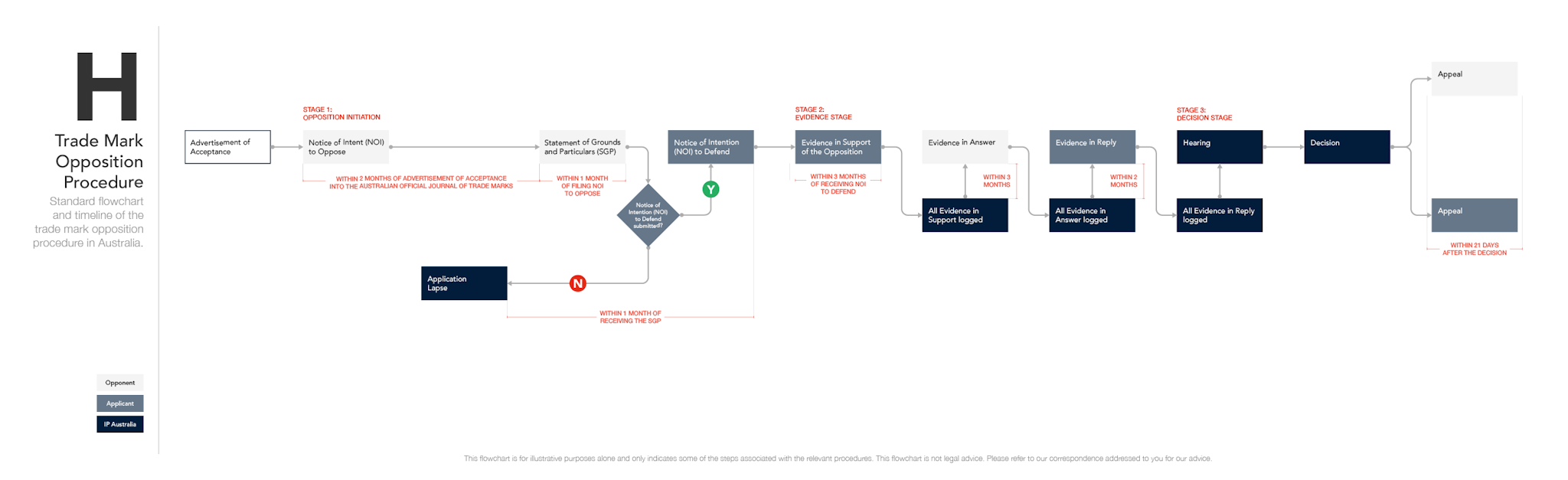
Notice of Intention to Oppose
A Notice of Intention to Oppose must be filed within two months from the date of an application being accepted and published. A Statement of Grounds and Particulars (SGP) must be submitted within one month after a notice is filed.
Notice of Intention to Defend
The Applicant will be forwarded the Notice of Intention to Oppose and Statement of Grounds and Particulars and given one month from the date of notification to file a Notice of Intention to Defend. If a Notice of Intention to Defend is not filed, the application will lapse and the opposition will be discontinued.
Evidence Stage
When the Applicant files a Notice of Intention to Defend, the opposition enters an evidence stage where both parties can submit their evidence and rebut the evidence filed by the other party.
The evidence stage is broken down into three sub-stages:
- Evidence in Support: Filed by the Opponent within three months from receiving the Notice of Intention to Defend. This includes declarations, documents, or expert reports substantiating the grounds.
- Evidence in Answer: Filed by the Applicant within three months from receiving the Evidence in Support, countering the opponent's claims.
- Evidence in Reply: Filed by the Opponent within two months from receiving the Evidence in Answer, limited to rebutting issues raised in the answer.
Evidence needs to be filed within prescribed time frames and shared electronically via IP Australia's Objective Connect platform.
Hearings
A trade mark opposition hearing is the final step of an opposition proceeding and it will take place at the request of either party within one month of the Evidence stage being finalised. Once the Hearing Officer has considered the submissions and evidence filed in the matter, they will provide a written decision usually within three to six months of the Hearing date and communicate it to the parties. It is also possible for a matter to be decided on the written record if neither party requests a Hearing.
Decision Stage
The Hearing Officer will issue a written decision after considering the evidence and submissions. Costs can may be awarded to the party in whose favour the matter is decided. Either party may file an appeal against the decision in the Federal Court or the Circuit Court within 21 days of the decision date.
Costs in Trade Mark Oppositions
Costs vary based on complexity and evidence volume. The main cost drivers are:
- Filing: the Notice of Intention to Oppose and the Statement of Grounds & Particulars.
- Evidence stages: each round of evidence, depending on the declarations and experts required.
- Hearing: the scale of the hearing and what counsel is engaged (e.g. a Barrister).
We provide a fixed cost estimate for each stage before it commences, so you can weigh the investment against the commercial value of the outcome at every step.
The successful party may receive a costs award.
Other Types of Trade Mark Oppositions
Beyond standard oppositions, you can challenge other IP Australia requests:
Opposing an Extension of Time of More Than Three Months
Under section 224 of the Trade Marks Act 1995 (Cth), an opposition may be filed against a request for an extension of time exceeding three months if the extension would disadvantage your position or lacks sufficient justification. To initiate the opposition, a notice of intention to oppose must be filed within one month of the request being advertised in the Australian Official Journal of Trade Marks, accompanied by the applicable fee.
Opposing an Amendment to a Trade Mark Application
Pursuant to section 65A of the Trade Marks Act 1995 (Cth), you may oppose a requested amendment to a trade mark application if it substantially affects the identity of the trade mark, broadens its scope, or otherwise impacts your rights. The opposition process begins by filing a notice of intention to oppose within one month of the amendment request being published in the Official Journal of Trade Marks.
Opposing Removal Applications for Non-Use
Trade mark registrations may be removed from the register where they are longer used by the registered owner, for the goods and/or services of the registration. A non-use removal action is one of the more common approaches for trade mark applicants to address conflicting prior registrations that are blocking their application. As a trade mark owner, you may be required to defend your registration by opposing a non-use application.
To defend against a non-use removal application under section 96 of the Trade Marks Act 1995 (Cth), the trade mark owner (as opponent) must file a Notice of Intention to Oppose within two months of the non-use application's advertisement in the Official Journal of Trade Marks, followed by a Statement of Grounds and Particulars (SGP) within one month thereafter. If no opposition is filed or the SGP is not submitted, the registration will be removed from the register.
If an opposition is lodged, the removal applicant must file a Notice of Intention to Defend (NID) within one month of receiving the SGP to pursue the removal; failure to do so results in the registration remaining on the register. The process then proceeds to the evidence rounds: Evidence in Support (filed by the opponent within three months), Evidence in Answer (filed by the removal applicant within three months), and Evidence in Reply (filed by the opponent within two months, limited to rebutting the answer). Following the evidence stage, either party may request a hearing (oral or by written submissions), after which the Hearing Officer issues a written decision, potentially awarding costs to the successful party. An appeal against the decision may be filed in the Federal Court or Federal Circuit Court of Australia within 21 days.
Baxter IP's Approach to Trade Mark Oppositions and Disputes
We evaluate new trade mark opposition matters from all angles. This helps us identify the most suitable strategy, whether filing, defending, or negotiating. Our services include sending or defending cease and desist notices to articulate your position and negotiate settlements that achieve your commercial objectives. We lodge trade mark oppositions to challenge accepted applications. We enforce your trade mark through negotiation or by supporting legal teams during alternative dispute resolution or Federal Court litigation. We focus resolutions on commercial objectives to prioritize business goals like coexistence where possible. We leverage our successful track record on IP disputes with outcomes before the Federal Court, IP Australia Hearings Department and in mediation and arbitration proceedings. We draw on our status as awarded IP dispute specialists. As one of the most awarded mid-sized IP firms in Australia, our team of trade mark attorneys handling disputes keeps us at the cutting edge of dispute strategy and processes.
Our approach involves an initial assessment of rights, grounds, and implications to thoroughly understand the dispute, strategy development for opposition, defense, or settlement to tailor solutions to your needs, evidence gathering and analysis including searches and expert opinions to build strong cases, and formal proceedings with transparent management and client communication to ensure alignment with business objectives throughout the process.
Why Choose Baxter IP for Your Trade Mark Opposition Needs?
In competitive markets, trade mark oppositions demand precise expertise. Our 717 active trade mark clients in FY24 trust us for results. With capped fees and large-firm systems at mid-tier rates, we're guided by dedication, transparency, and commercial focus.